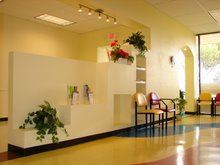
1. Many studies linking colors and moods have given insight and direction to many professions. Here we can see the gray of the cabinets and flooring create an atmosphere where a calm, civilized conversation takes place.

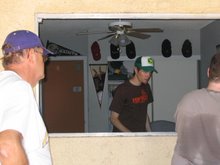
2. The stark contrast of calmness and business is almost lost when there is context. The context here is the sleeping cast member. Usually, when two conflicting concepts are joined into one frame one of the two is more dominant. The image to the left is perceived calmness and the image to the right, with the context removed, is very busy, drawing the eye all over the place.

3. The order of space and its spatial cohorts can be a very powerful device in how the human element interacts. There are clear and perceived boundaries within how this patio furniture is configured. As we have been discussing the Brickford's essay, it has become clear to me that the issues brought up are part of everyday life and different "people groups" can have very different perceptions of the same physical space.
 The "user" areas are defined in red, the yellow indicates a larger area that is meant for a social gathering/sense of comfort to be used by all cast members, the green indicates the perceived boundaries while blue physically defines obstacles (gates). Even though the open feel of the space is meant to encourage openness, free discussion and honest communication, there are still boundaries.
4. "Exterior Living" space, probably the most used s
 pace of the entire set, other than the maybe the bedrooms provides many levels of comfort, feel and use. Much like the previous screen shot there are common elements between the "levels" of this screen shot and the defined spaces and sense as discussed in the Brickford essay. Layered levels of materials are stacked upon each other. First I explored the "hard" surfaces, as indicated in the blue color group. I found what I could define as hard, then the soft. I thought that there would be some constant character that I would group together, no. What I found was that in each defined corner there was pattern. the same type of surfaces stacked on on the other. Fire pit on raised concrete patio, on concrete patio... billiards table on raised concrete patio on concrete patio. In the other direction there was layers of
 soft on soft, as indicated with the green "color group." Pillows on recliner on grass, pillows on pillows on couch. The Spa is a great example of a mixture of the two - soft and hard. This can represent what Susan was talking about, a mixture of the hard (public area) and soft (private area) co-existing in the same built environment.
Also the frame shows an example of the human element co-existing in the "hard" and "soft" environment sharing a game of billiards. As well as where the "soft" and "hard" are directly interacting, the couch on the concrete raised concrete patio. The most interesting part of this frame for me was (and I don't know this for sure) is that baby steps were taken, most likely as the "house guests" first were introduced to each other. First, there is human interaction, one on the "soft" surface the other on the "hard" surface sharing a common element. Then I would presume that after the idea of having "diversity" in such a small area the interaction started to take place in a common area, what all cast members (people groups) could call a private area (the soft surfaces).
Adapting to the diversity the final diagram indicates "people groups" can be in a public area and welcome others into a private area.